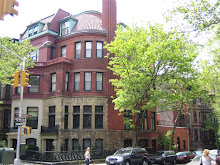
Carleton Club
Mercein Thomas, architect
1889-90
Regarding the Carleton Club, Mr. Gray tells us:
Three of the four were built within two years of one another. So competitive were the Brooklyn clubs that the Carlton (a k a Carleton) put up a headquarters in 1890 at Sixth and St. Marks Avenues in Park Slope simply because of rumors that another club was organizing to build nearby.
The Carlton had been dry, but after an 1889 meeting at which the membership voted, 38 to 11, to serve beer and wine, The Brooklyn Daily Eagle reported that it had “stepped to the front rank of Brooklyn clubs at a strike.”
This momentously fermentative change was thus in effect for the opening of the clubhouse, attended by 1,500 guests, including the mayors of Brooklyn and Manhattan. The club served a 10-course dinner, and members lent paintings by Jervis McIntee, George Inness and Eastman Johnson for the event. The Carlton was apparently designed by Mercein Thomas, and it is a mild, even modest, essay that could just as easily be a small apartment house, which indeed it has become.
In a lengthy article on March 9, 1890, the Brooklyn Eagle published a detailed review of the new club building and its facilities:

Brooklyn Eagle, March 9, 1890, p. 17 ("For the Carleton Club")
The review of the opening gala had appeared a few weeks earlier, on February 19, 1890.
Despite its auspicious beginnings, the Carleton Club apparently lasted only a few years. In 1907 the building became the home of the Cathedral Club of Brooklyn, a Roman Catholic social club. A long-time resident of Park Slope informs us that the Cathedral Club was established because Catholics were not allowed to join the nearby Montauk Club. [UPDATE: this story is apparently apocryphal... see comments below; thanks to "LGR".] According to the Cathedral Club's website, the group owned the building until 1974, when the building was sold and converted to its current residential use.