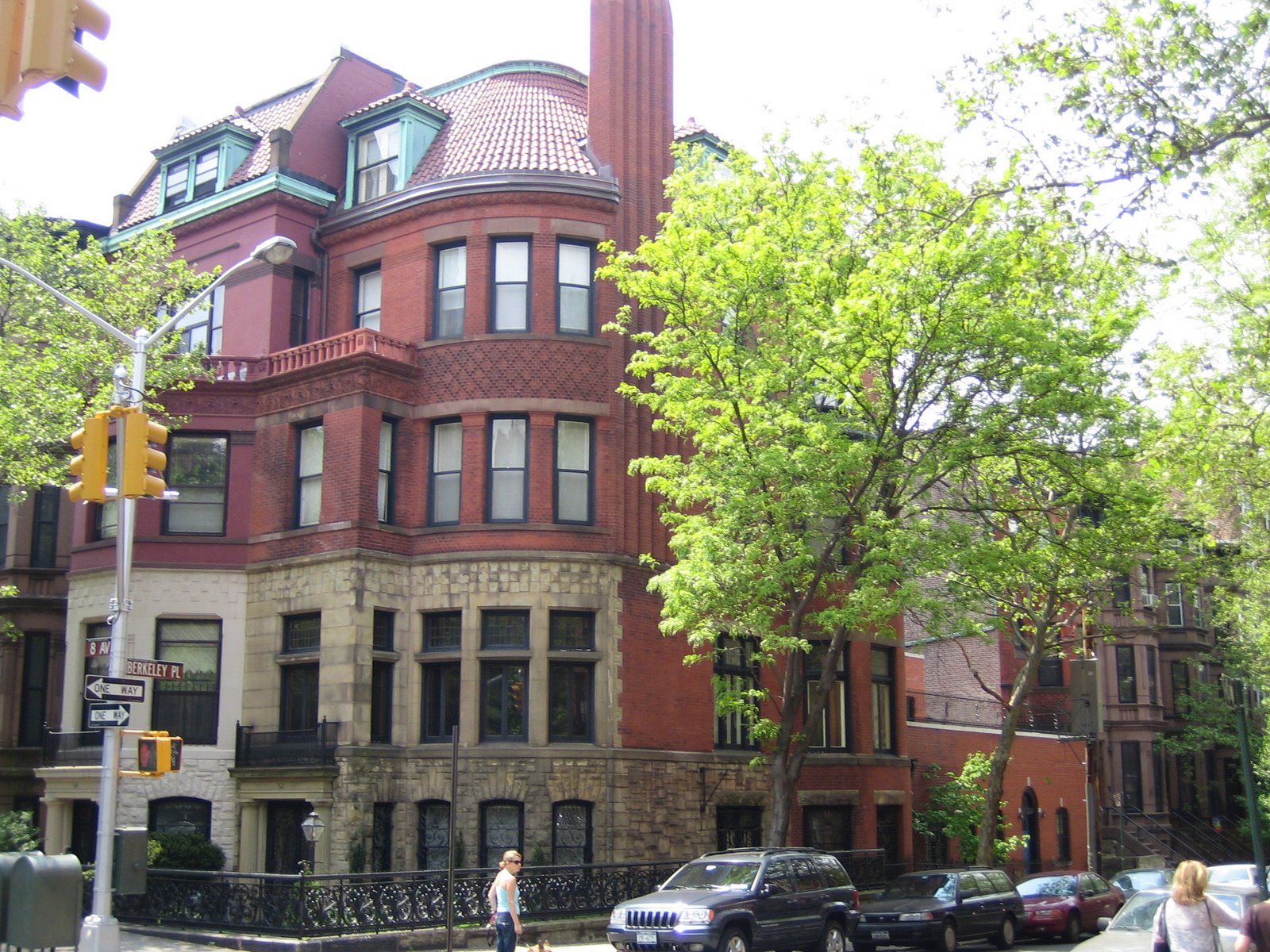
Before we turn our attention away from Park Slope's murals, note should be taken of some interesting trompe l'oeil work on the south side of Prospect Place between Flatbush & 6th Avenues in the north Slope. The side of the Italianate house at 96 Prospect Place, which overlooks an empty lot, has been enhanced with a bay window:
92 Prospect Place also has false windows painted on the side facade:
There are additional windows painted on the side of 84 Prospect Place, just visible on the right of the photograph above.
We know nothing for certain about these windows and would appreciate hearing from anyone who does. Email us via the Park Slope Civic Council website, or leave a message in the comments below.
However, a possible clue may be found in the "Murals" entry, written by Greta Berman, in the Encyclopedia of New York City, edited by Kenneth T. Jackson:
Trompe l'oeil was made popular by Richard Haas, whose first mural in the city was painted outside a loft on Prince Street in SoHo in 1974; his later work included a series of storefronts along Mulberry Street and murals for Prospect Place in Brooklyn... [p. 782]
Could the Encyclopedia article be referring to the Prospect Place murals shown above?
Richard Haas has a website wherein he lists his mural work. There are very few listings for Brooklyn, and no listing directly cites Prospect Place. However, the second-oldest listing cites "Brooklyn Gas & Electric, New York City". It is remotely conceivable that Brooklyn Union Gas could have commissioned distinguished muralist Richard Haas to create these murals, in a variation of BUG's "Cinderella" program to invest in Brooklyn's brownstone belt. However, we've looked all over the web and have found nothing (other than the Encyclopedia article) to support this theory.
Why this Blog Exists
To make the case for expanding the Park Slope Historic District
Showing posts with label Murals. Show all posts
Tuesday, October 27, 2009
Wednesday, October 21, 2009
More Park Slope Murals
Park Slope has other kinds of murals besides the community murals we have been reviewing in previous posts.
The south side of Union Street between 6th & 7th Avenues features the Dixon's Bike Shop mural, featuring a penny-farthing and Victorian-era cyclists:

Although we might call this a "commercial mural" rather than a "community mural", it is a very jolly mural nonetheless.
Another specialized mural form might be termed the memorial mural, created by neighbors to commemorate a beloved community member, often carried off too soon. The following example, from our comprehensive photo archive of Park Slope circa 2008, commemorates "Gee" who was taken in 2005, aged 22. The mural is from the south side of Degraw Street between 4th & 5th Avenues:
The south side of Union Street between 6th & 7th Avenues features the Dixon's Bike Shop mural, featuring a penny-farthing and Victorian-era cyclists:
Although we might call this a "commercial mural" rather than a "community mural", it is a very jolly mural nonetheless.
Another specialized mural form might be termed the memorial mural, created by neighbors to commemorate a beloved community member, often carried off too soon. The following example, from our comprehensive photo archive of Park Slope circa 2008, commemorates "Gee" who was taken in 2005, aged 22. The mural is from the south side of Degraw Street between 4th & 5th Avenues:
Sunday, October 18, 2009
Water is the Life of NYC
Water is the Life of NYC is Park Slope's most recent community mural. Another project of the Groundswell mural group, it was completed in 2008 and depicts New York City's water cycle. The mural overlooks the corner of 4th Avenue and Sackett Street, where there is an entrance to the city's water tunnel no. 3. The course of water from the Catskills reserviors, over the Croton Dam, and through the tunnel system to city residents' taps serves as the mural's "connecting device".
From the Groundswell website:
The system of delivery of water from the rural New York to NYC is depicted in an effort to make New Yorkers more aware of how precious their water is. The allegorical figure of Mother Nature hovers over the two main reservoirs that feed water to the city. The Sandhogs, the urban miners who dig the tunnels to bring the water to the city, are depicted digging a third water tunnel. Elements of the urban and rural environments are shown together in harmony while in the central image and focal point of the mural, people are encouraged to drink tap water in reusable bottles.
The mural is aimed at “raising consciousness of how precious water is as a resource to us”, says team participant Christina Cacioppo. Alongside the mural the team also developed a pledge urging people to follow guidelines for water conservation. Anyone signing the pledge received a sticker also designed by the team. Fellow team member Zane Smith added, “This mural reflects the global issue of water as a precious resource, and as only seven percent of the world’s water is drinkable we shouldn’t take our water for granted”. Team member Federico Tenorio stated “the purpose of the mural is to also show where the water comes from and how it gets to us”.
If "murals are the people's blackboard", as Pablo Neruda has said, then it is interesting to compare the iconography of Water is the Life of NYC with earlier murals in Park Slope. Gone are the raised fists of resistance, imperialist eagles, flames and other violent imagery, replaced by depictions of harmony with nature, in keeping with the resurgence of ecological thinking in society today. Even the Park Slope Civic Council, through its local community grants program, contributed funds to help create this mural!
The mural certainly enlivens what was previously a rather dreary corner; the photo below is from our comprehensive Park Slope photographic survey and shows the site before the mural was installed:
Tuesday, October 13, 2009
Peace is Not a Dream in Storage
The Rite Aid at the southwest corner of 5th Avenue and 10th Street in Park Slope has come in for its share of abuse on this blog.
But only when we read On the Wall: Four Decades of Community Murals in New York City by Janet Braun-Reinitz and Jane Weismann did we realize the role this Rite Aid played in another nasty fight over a community mural in Park Slope.
Our last post reviewed the unfortunate events surrounding the destruction of Mary Patten's First Street Mural in 1977. Park Slope was apparently to wait over 20 years for its next community mural, and it too was destroyed prematurely because of the opposition of nearby residents.
The 10th Street mural was organized by the new Groundswell organization, incorporated in 1998. Peace is Not a Dream in Storage was a response to a series of attacks on women using the 9th Street/4th Avenue subway station in 1999. Groundswell organized a group of teen-aged girls from the nearby Center for Anti-Violence Education to serve as the mural's artists. According to the authors of On the Wall:
Not until the mural was finished did objections -- never previously expressed -- arise from a small segment of the community. Cultural differences and fears about race, gentrification, and property values ultimately led to the mural's destruction.
At the mural dedication, amidst the controversy, the young artists eloquently stated the mural's intent and what they hoped it would achieve: "We wanted to send a strong message that problems need to be solved, not hidden away in a box... We want to publicly express our cumulative disgust with violence...
Instead of entering into a dialogue with the artists and the mural sponsors, a small group of residents circulated a petition demanding that Rite Aid "remove this insulting and ugly mural" because, in the words of one homeowner, "it makes "our 'hood look ghettoish".
A Rite Aid representative, to his/her credit, initially backed the mural and tried to facilitate a meeting between Groundswell, the artists, and nearby residents, in order to resolve differences. A series of talks and meetings dragged on for months. Ultimately Rite Aid turned against Groundswell and the artists, and the mural disappeared under a coat of whitewash.
A contemporary account of the controversy can be found in the New York Times archive, here.
One begins to suspect, after the premature destruction of Mary Patten's First Street Mural, and of Groundswell's Peace is not a Dream in Storage, more than 20 years later, that Park Slope is particularly inhospitable to community murals. Why is that, we wonder?
One also suspects that Ride Aid's corporate policies were soon changed to preclude any possibility that such an unpleasant situation could ever recur. The idea that a store manager would even permit a community mural to be painted on the side of the store seems almost quaint these days. Even if he or she liked the idea, one suspects the current corporate policy says, in effect, that "no unauthorized store decoration shall be undertaken by any manager" and that failure to comply with this policy is tantamount to "voluntary resignation".
Tuesday, October 6, 2009
Mary Patten's First Street Mural
Buoyed by the success of her 1976 Douglass Street Mural, Mary Patten commenced plans the following year for another community mural in First Street, just above Fifth Avenue. It was perhaps another attempt to heal the animosities exposed by the Park Slope riot, just a few years past.
The authors of On the Wall: Four Decades of Community Murals in New York City describe Patten's approach to the First Street Mural, and the differences between this project and the Douglass Street Mural:
Seven blocks separated the two projects, presenting Patten with a new set of residents, mostly white, with different values and concerns. For the First Street Mural (1977), Patten recruited local teen artists from the Youth Corps summer employment program. Its low-paying jobs rarely attracted the area's white youth, who were more likely to gain employment in the private sector, and the teens of color who were hired considered themselves lucky to get jobs.
One already suspects that this project is perhaps going to encounter difficulties. If the mostly white residents were not already uneasy by "outsiders" coming onto their block, they became truly alarmed when they saw the actual designs for the mural:
In the mural, long lines of youth wait for non-existent jobs, fights break out over the few existing opportunities, and a policeman with a nightstick arrests a protesting youth...
The first concerns were voiced... at a First Street block party where "there was a handful of people -- white homeowners -- who felt the mural theme was 'too violent, too political' and did not contain enough unity images"...
The group began to paint, but as the mural neared completion, the artists heard rumors that some First Street residents wanted to whitewash the wall. The rumors were true. Before the artists could organze a community meeting, the mural was defaced, bombed by white paint, the perpetrator or perpetrators unknown. The muralists were quick to point out the irony of the act that people criticizing the imagery as violent had ignored the violence inherent not only in the mural's defacement but also in the racial insults later hurled at the artists.
There is a heartbreaking photograph of the defaced mural in On the Wall. The imagery seems entirely consistent with the many other community murals of its time, combining depictions of challenges faced by the city's youth, together with more hopeful images of a diverse group of residents, coming together in common cause, working in unity for more jobs, better housing, equal justice, and an end to racism.
The artists were devastated by the racism and the hatred underlying the comments expressed by some white residents: "There are too many Black people in the picture," and "Black and Latino teenagers could never have thought up this mural in the first place." The main objection to the mural likely was the fear expressed by one resident: "It's going to bring down property values."
After a period of impasse, permission for the mural was rescinded by the apartment building on which it was painted, and the defaced mural was whitewashed in the middle of the night.
On the Wall's authors, Janet Braun-Reinitz and Jane Weissman, frequently emphasize the fragile nature of community murals: a mural can fall into disrepair; its host building can be demolished; a new building can arise to block an existing mural; a wall on which it is painted can require repair or rebuilding. In the case of the First Street Mural, however, the project lost the essential community support on which every mural depends.
One still finds a faint trace of the First Street Mural today, on the north side of First Street, just above 5th Avenue. The mural covered only the first few stories of the apartment building overlooking the parking lot, and the whitewashed wall remains today, a kind of palimpsest of the aborted community mural and the drama that briefly surrounded it:
Sunday, September 27, 2009
Mary Patten's Douglass Street Mural
Murals are the people's blackboard.
-Pablo Neruda
So begins On the Wall: Four Decades of Community Murals in New York City, by Janet Braun-Reinitz and Jane Weissman.

Last week we were privileged to attend a fascinating illustrated talk by Ms. Weissman about the history of community murals in New York. We have written previously about the Park Slope murals of Mary Patten, member of the circa-1970s Madame Binh Graphics Collective, and brought home a copy of On the Wall so that we could learn more about community murals in general, and Park Slope's murals in particular.
The authors define community murals as
collaborations among artists, neighborhood groups, and mural organizations... A singular art form, these large-scale and site-specific works reflect the social, cultural, and political climate of their times and the neighborhoods in which they are located. Community murals beautify, educate, protest, celebrate, affirm, organize, and motivate residents to action.
Park Slope has had a somewhat complicated history with community murals.
Our first community mural was apparently Mary Patten's "Douglass Street Mural" of 1976:
Concerning the Douglass Street Mural, the authors of On the Wall write:
[Patten] lead a team of twenty teens and adults through a five-month process to develop the themes and imagery... Seeking community input and consensus... the team posted bilingual flyers, canvassed local residents, and organized community meetings. The Douglass Street Mural takes great advantage of the architecture of two adjacent building walls that suggest the facing pages of an open book. In her bold design, Patten powerfully transforms images that in a lesser hand would be overused cliches. At the mural's dedication, two of the young artists directed viewer attention to the right wall, with its angry bolt of lightening and imperialist eagle clasping a puppetlike figure in its talons. Under them are images representing redlining, racism, and the firebombing that had recently destroyed the homes of several Black families just blocks away. The artists then pointed to the shining rainbow on the left wall, showing "what is possible when people work and fight together to [create] what we need: a community school that provides quality education; people sharing skills and tools; dancing together; making music and painting a mural...
In the late 1980s, new housing obscured the mural, and its loss elicited widespread expressions of sadness in the neighborhood.
By comparing building details in the mural photograph with present-day photographs in our comprehensive photo survey of Park Slope, we have identified the mural's location as the west wall of 389 Douglass Street, the older building on the left in the photo below. The newer housing that obscured the mural is visible to the left of #389:
On the Wall's authors cite Patten's Douglass Street Mural as a highly successful example of a community mural, one that was welcomed and valued by the community. Unfortunately, Patten's next effort, the First Street Mural of 1977, which we will examine in a subsequent post, did not work out nearly so well.
Subscribe to:
Posts (Atom)