Buoyed by the success of her 1976 Douglass Street Mural, Mary Patten commenced plans the following year for another community mural in First Street, just above Fifth Avenue. It was perhaps another attempt to heal the animosities exposed by the Park Slope riot, just a few years past.
The authors of On the Wall: Four Decades of Community Murals in New York City describe Patten's approach to the First Street Mural, and the differences between this project and the Douglass Street Mural:
Seven blocks separated the two projects, presenting Patten with a new set of residents, mostly white, with different values and concerns. For the First Street Mural (1977), Patten recruited local teen artists from the Youth Corps summer employment program. Its low-paying jobs rarely attracted the area's white youth, who were more likely to gain employment in the private sector, and the teens of color who were hired considered themselves lucky to get jobs.
One already suspects that this project is perhaps going to encounter difficulties. If the mostly white residents were not already uneasy by "outsiders" coming onto their block, they became truly alarmed when they saw the actual designs for the mural:
In the mural, long lines of youth wait for non-existent jobs, fights break out over the few existing opportunities, and a policeman with a nightstick arrests a protesting youth...
The first concerns were voiced... at a First Street block party where "there was a handful of people -- white homeowners -- who felt the mural theme was 'too violent, too political' and did not contain enough unity images"...
The group began to paint, but as the mural neared completion, the artists heard rumors that some First Street residents wanted to whitewash the wall. The rumors were true. Before the artists could organze a community meeting, the mural was defaced, bombed by white paint, the perpetrator or perpetrators unknown. The muralists were quick to point out the irony of the act that people criticizing the imagery as violent had ignored the violence inherent not only in the mural's defacement but also in the racial insults later hurled at the artists.
There is a heartbreaking photograph of the defaced mural in On the Wall. The imagery seems entirely consistent with the many other community murals of its time, combining depictions of challenges faced by the city's youth, together with more hopeful images of a diverse group of residents, coming together in common cause, working in unity for more jobs, better housing, equal justice, and an end to racism.
The artists were devastated by the racism and the hatred underlying the comments expressed by some white residents: "There are too many Black people in the picture," and "Black and Latino teenagers could never have thought up this mural in the first place." The main objection to the mural likely was the fear expressed by one resident: "It's going to bring down property values."
After a period of impasse, permission for the mural was rescinded by the apartment building on which it was painted, and the defaced mural was whitewashed in the middle of the night.
On the Wall's authors, Janet Braun-Reinitz and Jane Weissman, frequently emphasize the fragile nature of community murals: a mural can fall into disrepair; its host building can be demolished; a new building can arise to block an existing mural; a wall on which it is painted can require repair or rebuilding. In the case of the First Street Mural, however, the project lost the essential community support on which every mural depends.
One still finds a faint trace of the First Street Mural today, on the north side of First Street, just above 5th Avenue. The mural covered only the first few stories of the apartment building overlooking the parking lot, and the whitewashed wall remains today, a kind of palimpsest of the aborted community mural and the drama that briefly surrounded it:
Why this Blog Exists
To make the case for expanding the Park Slope Historic District
Showing posts with label Patten. Show all posts
Tuesday, October 6, 2009
Friday, October 2, 2009
The 1973 Park Slope Riot
As we wrote our previous post about Mary Patten's Douglass Street Mural, we were struck by the On the Wall authors' assertion that several Black families had been firebombed out of their homes in lower Park Slope in the mid-1970s. We could not simply pass this assertion by, so we tried to research those events. And although we were unable to discover more about those particular incidents, we did stumble upon something else that provides insight into the social conditions from which Mary Patten's community murals emerged: the Park Slope riot of 1973.
In those days, Park Slope's 5th Avenue was vastly different from the baby-carriage-clogged restaurant row that it is today. Union Street was the dividing line between a largely Italian community to the south, and a growing Puerto Rican community to the north. Tensions between these communities simmered along 5th Avenue; the intersection of 5th Avenue and Union Street was the epicenter of this tension; and Park Slope exploded in late June of 1973.
Tuesday, June 26, 1973, was primary day, and Puerto Rican candidate Herman Badillo was in a tight race for nomination in the Democratic mayoral primary runoff election. He lost narrowly that day to Abe Beame. Late that evening, a car pulled up in front of 6 Berkeley Place, just above 5th Avenue. Armed men emerged, firing at two Puerto Rican brothers who were sitting on the stoop, wounding both. The assailants drove off, yelling "if Badillo had won, we would have killed you!"
Word of the assault spread quickly on Wednesday, June 27, and as darkness fell, large groups of Puerto Rican and Italian Park Slopers gathered near the intersection of 5th Avenue and Union Street. Insults were hurled; then bottles and bricks; then people began throwing hundreds of fireworks; and the riot was on, with windows smashed, cars firebombed, and finally gunfire exchanged along 5th Avenue. Five youths were shot, and five police were injured trying to break up the fight:
The worst injured was 15-year-old Jose Colon, shot through the neck and paralyzed from the neck down. The next day, police found spent .22-caliber shells atop 238 5th Avenue (now the Sunflower Academy), on the Italian side, and later found a rifle with sniperscope on the building's fire escape.
News accounts note that the windows of the Manufacturer's Hanover Bank branch at the corner 5th Avenue and Union street were smashed out, and the building was firebombed; presumably it was the building on the southeast corner:
Interestingly, the New York Times accounts indicate that the ground-floor apartment at 6 Berkeley Place, where the initial attack occurred, was "the headquarters of a Puerto Rican political group called the Machetes." A detective noted that "this is not a gang, but a political organization that wants independence for Puerto Rico," and a member of the group indicated that it was an offshoot of the Young Lords, a radical Puerto Rican social service organization modeled somewhat after the Black Panthers:
A 2006 Times account of the riot notes that the Machetes were "by some accounts a street gang and by others a Marxist political group."
The Machetes, or Macheteros, are apparently still in existence today, a clandestine organization still fighting for Puerto Rican independence. They are also called the Boricua Popular Army and are described by the FBI as a terrorist group.
Below, Puerto Rican residents of Park Slope, standing in front of the ground-floor Macheteros headquarters at 6 Berkeley Place:
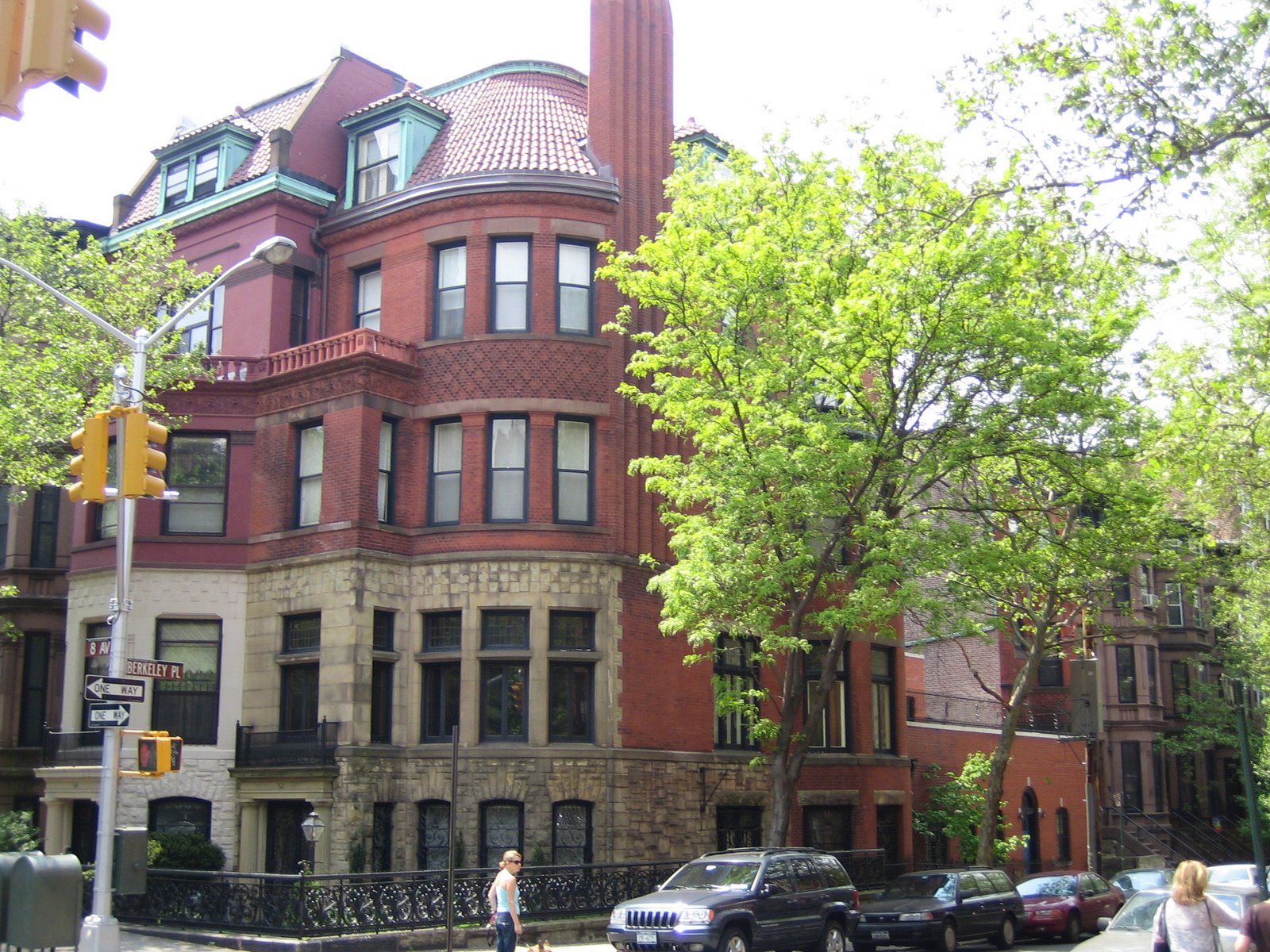
The detailing above the ground floor windows has been shaved off since the New York Times photograph was taken in 1973, but the location of the Times photograph is easily recognizable today:
The 1973 Park Slope riot had a sad coda three decades later, in 2004, when Jose Colon, the 15-year-old shot through the neck on the night of the riot, ultimately died. The wound was said to be a contributing factor in his death. The shooter, who had earlier served three years on a charge of reckless endangerment, was then charged with 2nd degree murder, but ultimately pleaded guilty to a lesser charge of manslaughter in 2006 and was sentenced to two to six years.
Such was the charged atmosphere of lower Park Slope in which Mary Patten soon began to organize around the creation of her Douglass Street Mural, which both frankly acknowledged the reality of social conflict, but also pointed toward the possibility of communities working together in cooperation.
One could make the case that Park Slope's tradition of cooperation was already quite evident in 1973. Historian Francis Morrone, in his recent book about Park Slope, notes that the riots occurred just one month before the current Park Slope Historic District was designated in July, 1973. And as the Park Slope Food Coop's sign in Union Street declares, the Coop was "est. 1973".
In those days, Park Slope's 5th Avenue was vastly different from the baby-carriage-clogged restaurant row that it is today. Union Street was the dividing line between a largely Italian community to the south, and a growing Puerto Rican community to the north. Tensions between these communities simmered along 5th Avenue; the intersection of 5th Avenue and Union Street was the epicenter of this tension; and Park Slope exploded in late June of 1973.
Tuesday, June 26, 1973, was primary day, and Puerto Rican candidate Herman Badillo was in a tight race for nomination in the Democratic mayoral primary runoff election. He lost narrowly that day to Abe Beame. Late that evening, a car pulled up in front of 6 Berkeley Place, just above 5th Avenue. Armed men emerged, firing at two Puerto Rican brothers who were sitting on the stoop, wounding both. The assailants drove off, yelling "if Badillo had won, we would have killed you!"
Word of the assault spread quickly on Wednesday, June 27, and as darkness fell, large groups of Puerto Rican and Italian Park Slopers gathered near the intersection of 5th Avenue and Union Street. Insults were hurled; then bottles and bricks; then people began throwing hundreds of fireworks; and the riot was on, with windows smashed, cars firebombed, and finally gunfire exchanged along 5th Avenue. Five youths were shot, and five police were injured trying to break up the fight:
The worst injured was 15-year-old Jose Colon, shot through the neck and paralyzed from the neck down. The next day, police found spent .22-caliber shells atop 238 5th Avenue (now the Sunflower Academy), on the Italian side, and later found a rifle with sniperscope on the building's fire escape.
News accounts note that the windows of the Manufacturer's Hanover Bank branch at the corner 5th Avenue and Union street were smashed out, and the building was firebombed; presumably it was the building on the southeast corner:
A 2006 Times account of the riot notes that the Machetes were "by some accounts a street gang and by others a Marxist political group."
The Machetes, or Macheteros, are apparently still in existence today, a clandestine organization still fighting for Puerto Rican independence. They are also called the Boricua Popular Army and are described by the FBI as a terrorist group.
Below, Puerto Rican residents of Park Slope, standing in front of the ground-floor Macheteros headquarters at 6 Berkeley Place:
Such was the charged atmosphere of lower Park Slope in which Mary Patten soon began to organize around the creation of her Douglass Street Mural, which both frankly acknowledged the reality of social conflict, but also pointed toward the possibility of communities working together in cooperation.
One could make the case that Park Slope's tradition of cooperation was already quite evident in 1973. Historian Francis Morrone, in his recent book about Park Slope, notes that the riots occurred just one month before the current Park Slope Historic District was designated in July, 1973. And as the Park Slope Food Coop's sign in Union Street declares, the Coop was "est. 1973".
Labels:
5th Avenue,
Berkeley Place,
Macheteros,
Patten,
Union Street
Sunday, September 27, 2009
Mary Patten's Douglass Street Mural
Murals are the people's blackboard.
-Pablo Neruda
So begins On the Wall: Four Decades of Community Murals in New York City, by Janet Braun-Reinitz and Jane Weissman.

Last week we were privileged to attend a fascinating illustrated talk by Ms. Weissman about the history of community murals in New York. We have written previously about the Park Slope murals of Mary Patten, member of the circa-1970s Madame Binh Graphics Collective, and brought home a copy of On the Wall so that we could learn more about community murals in general, and Park Slope's murals in particular.
The authors define community murals as
collaborations among artists, neighborhood groups, and mural organizations... A singular art form, these large-scale and site-specific works reflect the social, cultural, and political climate of their times and the neighborhoods in which they are located. Community murals beautify, educate, protest, celebrate, affirm, organize, and motivate residents to action.
Park Slope has had a somewhat complicated history with community murals.
Our first community mural was apparently Mary Patten's "Douglass Street Mural" of 1976:
Concerning the Douglass Street Mural, the authors of On the Wall write:
[Patten] lead a team of twenty teens and adults through a five-month process to develop the themes and imagery... Seeking community input and consensus... the team posted bilingual flyers, canvassed local residents, and organized community meetings. The Douglass Street Mural takes great advantage of the architecture of two adjacent building walls that suggest the facing pages of an open book. In her bold design, Patten powerfully transforms images that in a lesser hand would be overused cliches. At the mural's dedication, two of the young artists directed viewer attention to the right wall, with its angry bolt of lightening and imperialist eagle clasping a puppetlike figure in its talons. Under them are images representing redlining, racism, and the firebombing that had recently destroyed the homes of several Black families just blocks away. The artists then pointed to the shining rainbow on the left wall, showing "what is possible when people work and fight together to [create] what we need: a community school that provides quality education; people sharing skills and tools; dancing together; making music and painting a mural...
In the late 1980s, new housing obscured the mural, and its loss elicited widespread expressions of sadness in the neighborhood.
By comparing building details in the mural photograph with present-day photographs in our comprehensive photo survey of Park Slope, we have identified the mural's location as the west wall of 389 Douglass Street, the older building on the left in the photo below. The newer housing that obscured the mural is visible to the left of #389:
On the Wall's authors cite Patten's Douglass Street Mural as a highly successful example of a community mural, one that was welcomed and valued by the community. Unfortunately, Patten's next effort, the First Street Mural of 1977, which we will examine in a subsequent post, did not work out nearly so well.
Saturday, March 14, 2009
Mary Patten, Park Slope Muralist
We interrupt our regularly scheduled programming to present an update from the much more recent past, circa-1970s Park Slope.
Throughout the '70s, '80s, and even into the present day, a movement to create wall murals has existed on the margins of gentrified Brooklyn. This movement has recently been chronicled in a new book, On the Wall: Four Decades of Community Murals in New York City, from the University Press of Mississippi, reviewed in the March, 2009 Brooklyn Rail.
What caught our attention was a reference to a mural entitled "Douglass Street Mural", by Mary Patten:

In seeming contradiction to the mural's title, the review attributes the mural to "First Street" in Park Slope. Perhaps there was more than one mural by Mary Patten? Does anyone remember these murals?
Unfortunately the mural, wherever it was, seems not to have been entirely welcomed by "community members" who feared it would "bring down property values". The controversy ended when the mural was "obliterated by paint bombs".
"'On The Wall' describes artist Mary Patten’s 1977 First Street Mural in Park Slope, a work created with teens from Project Reach Youth. The theme, opposition to the era’s pervasive redlining and arson for profit, rankled community members who saw the depiction as overly combative and likely to 'bring down property values.' The searing conflict ended when the mural was obliterated by paint bombs."
This community intervention is interesting enough on its own terms.
But what really compelled our interest was the name of the artist, Mary Patten.
Fast forward 30 years, to last fall's "Signs of Change" exhibition at Exit Art in Manhattan, a show of graphic art in support of social movements over the past 40 years, curated by Dara Greenwald and Josh McPhee.
A "zine" was distributed at the exhibit, entitled "Revolution as an Eternal Dream: The Exemplary Failure of the Madame Binh Graphics Collective", which chronicled the activities of an above-ground graphic arts wing loosely affiliated with the Weather Underground in 1970s Brooklyn. It provided a fascinating insight into the radical-left marginal communities in and around Park Slope, circa 1970s. (A correspondent informs us that the Madame Binh Graphics Collective was located on Taaffe Place.) Actually, the communities only seem "marginal" by today's presentist standards. As the 'zine makes clear, in the charged atmosphere of the 1970s, revolution was "in the air" and it seemed as if a new world was coming into being any moment, which must have made for heady times indeed.
And the name of the author of this "zine"?:
Mary Patten.
Thus we recover another fragment of Park Slope's lost or suppressed history of the radical fringe communities, circa 1970s.
Throughout the '70s, '80s, and even into the present day, a movement to create wall murals has existed on the margins of gentrified Brooklyn. This movement has recently been chronicled in a new book, On the Wall: Four Decades of Community Murals in New York City, from the University Press of Mississippi, reviewed in the March, 2009 Brooklyn Rail.
What caught our attention was a reference to a mural entitled "Douglass Street Mural", by Mary Patten:
In seeming contradiction to the mural's title, the review attributes the mural to "First Street" in Park Slope. Perhaps there was more than one mural by Mary Patten? Does anyone remember these murals?
Unfortunately the mural, wherever it was, seems not to have been entirely welcomed by "community members" who feared it would "bring down property values". The controversy ended when the mural was "obliterated by paint bombs".
But what really compelled our interest was the name of the artist, Mary Patten.
Fast forward 30 years, to last fall's "Signs of Change" exhibition at Exit Art in Manhattan, a show of graphic art in support of social movements over the past 40 years, curated by Dara Greenwald and Josh McPhee.
A "zine" was distributed at the exhibit, entitled "Revolution as an Eternal Dream: The Exemplary Failure of the Madame Binh Graphics Collective", which chronicled the activities of an above-ground graphic arts wing loosely affiliated with the Weather Underground in 1970s Brooklyn. It provided a fascinating insight into the radical-left marginal communities in and around Park Slope, circa 1970s. (A correspondent informs us that the Madame Binh Graphics Collective was located on Taaffe Place.) Actually, the communities only seem "marginal" by today's presentist standards. As the 'zine makes clear, in the charged atmosphere of the 1970s, revolution was "in the air" and it seemed as if a new world was coming into being any moment, which must have made for heady times indeed.
And the name of the author of this "zine"?:
Mary Patten.
Thus we recover another fragment of Park Slope's lost or suppressed history of the radical fringe communities, circa 1970s.
Subscribe to:
Posts (Atom)