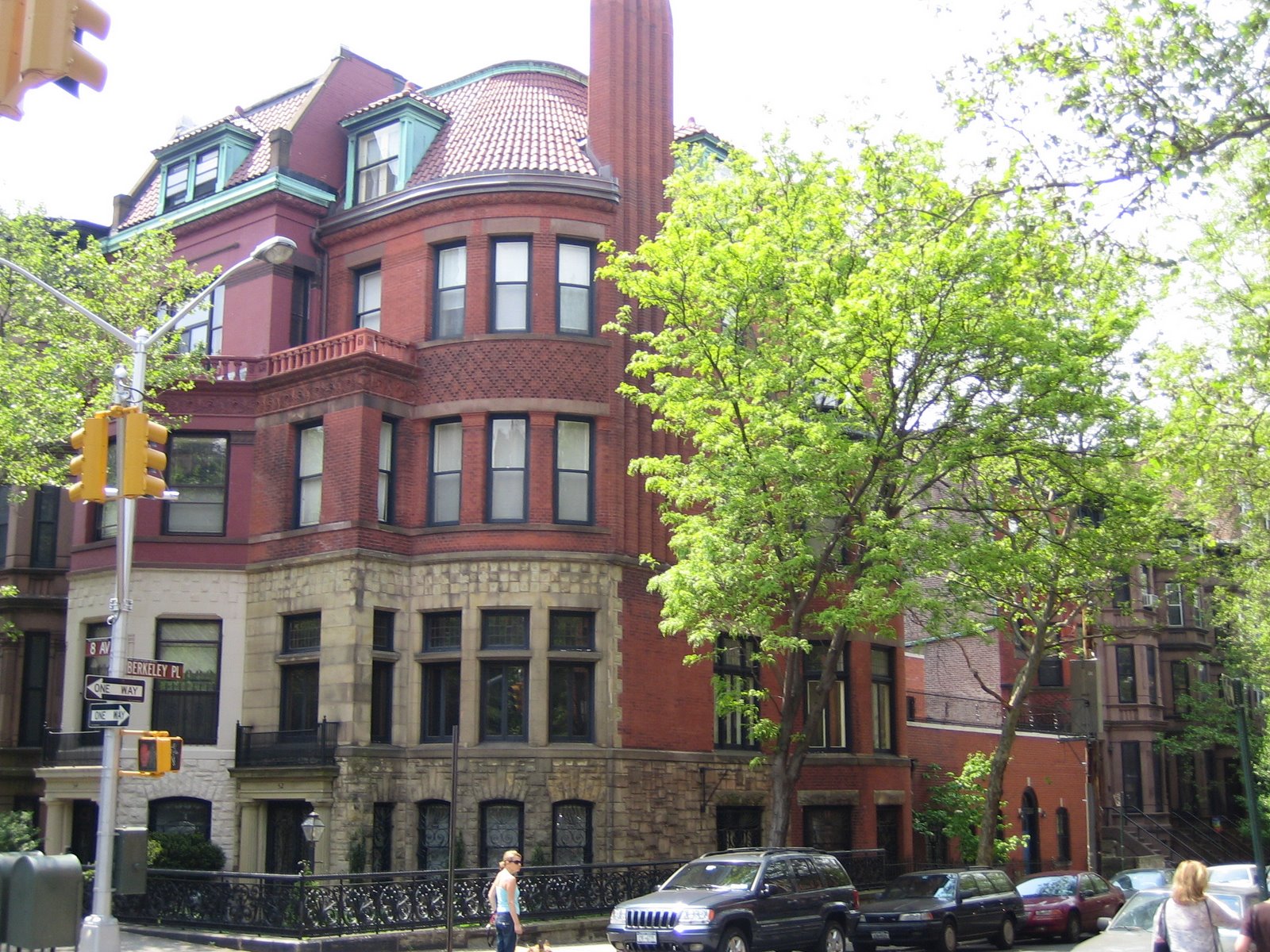
Sigh.... here we go again... according to a letter in this week's Brooklyn Paper, "the extension of the Park Slope landmark district will contribute significantly to the exclusion of future new middle class homeowners, helping make Park Slope a less diverse neighborhood, economically."
The writer continues:
"I would like to have a neighborhood where newly arrived, middle-class neighbors can imagine moving, working to raise their children, and paying their mortgage — like me. The real irony is, in the South Slope that is what we have without landmarking."
Actually, we hate to break it to you, but the irony is, the South Slope is not a neighborhood where "newly-arrived middle class families" can move in and raise their families. Even without landmarking.
Let's do a price check... just the other day, Brownstoner listed the results of a public auction that included 482 7th Street, a 3-family, brownstone-faced building on the south side of 7th Street, between 7th and 8th Avenues. The building is in the proposed first phase extension of the historic district, and part of a block we have discussed before on this blog (it is identical to the house, 2 doors away, shown below):
The auction price of this "affordable to the middle-class" house in the South Slope? Get ready for the "real irony":
$1,600,000.
And this building isn't in the historic district.
We preservationists are often accused of being "delusional," of wanting to walk around in a fantasy land of fake-old lampposts etc. (Except, we invite anyone to find any appeal for fake-old lampposts on this blog... you will search in vain.)
But the idea that a $1,600,000 house is affordable to anyone in the "middle class" seems totally delusional to us.
Perhaps the battle to keep the South Slope "affordable" has nothing to do with landmarking, and has already been lost, years ago? Could there perhaps be larger economic forces at work?
Meanwhile, in the "lower Slope", west of 5th Avenue, one finds housing that still might be slightly "affordable" to the "middle class". Often it is in older, walk-up "flat houses" or small apartment buildings from the late 19th century. Unfortunately this older housing is increasingly being ripped out and replaced by "luxury" condo developments.
Case in point: the following groups of buildings stand across the street from each other in Sackett Street between 4th and 5th Avenues. If you were looking to rent an apartment, in which building do you think you'd find a more reasonable rent? Which group of buildings is historic, and which is a new development?
The new development even has off-street parking for residents in the rear, with a "convenient drive-thru" passageway protected by an automatic gate, quite like the automatic garage door openers one finds in the suburbs.
Which buildings look more "affordable" to you?
Why this Blog Exists
To make the case for expanding the Park Slope Historic District
Showing posts with label Sackett Street. Show all posts
Sunday, December 19, 2010
Sunday, October 18, 2009
Water is the Life of NYC
Water is the Life of NYC is Park Slope's most recent community mural. Another project of the Groundswell mural group, it was completed in 2008 and depicts New York City's water cycle. The mural overlooks the corner of 4th Avenue and Sackett Street, where there is an entrance to the city's water tunnel no. 3. The course of water from the Catskills reserviors, over the Croton Dam, and through the tunnel system to city residents' taps serves as the mural's "connecting device".
From the Groundswell website:
The system of delivery of water from the rural New York to NYC is depicted in an effort to make New Yorkers more aware of how precious their water is. The allegorical figure of Mother Nature hovers over the two main reservoirs that feed water to the city. The Sandhogs, the urban miners who dig the tunnels to bring the water to the city, are depicted digging a third water tunnel. Elements of the urban and rural environments are shown together in harmony while in the central image and focal point of the mural, people are encouraged to drink tap water in reusable bottles.
The mural is aimed at “raising consciousness of how precious water is as a resource to us”, says team participant Christina Cacioppo. Alongside the mural the team also developed a pledge urging people to follow guidelines for water conservation. Anyone signing the pledge received a sticker also designed by the team. Fellow team member Zane Smith added, “This mural reflects the global issue of water as a precious resource, and as only seven percent of the world’s water is drinkable we shouldn’t take our water for granted”. Team member Federico Tenorio stated “the purpose of the mural is to also show where the water comes from and how it gets to us”.
If "murals are the people's blackboard", as Pablo Neruda has said, then it is interesting to compare the iconography of Water is the Life of NYC with earlier murals in Park Slope. Gone are the raised fists of resistance, imperialist eagles, flames and other violent imagery, replaced by depictions of harmony with nature, in keeping with the resurgence of ecological thinking in society today. Even the Park Slope Civic Council, through its local community grants program, contributed funds to help create this mural!
The mural certainly enlivens what was previously a rather dreary corner; the photo below is from our comprehensive Park Slope photographic survey and shows the site before the mural was installed:
From the Groundswell website:
The system of delivery of water from the rural New York to NYC is depicted in an effort to make New Yorkers more aware of how precious their water is. The allegorical figure of Mother Nature hovers over the two main reservoirs that feed water to the city. The Sandhogs, the urban miners who dig the tunnels to bring the water to the city, are depicted digging a third water tunnel. Elements of the urban and rural environments are shown together in harmony while in the central image and focal point of the mural, people are encouraged to drink tap water in reusable bottles.
The mural is aimed at “raising consciousness of how precious water is as a resource to us”, says team participant Christina Cacioppo. Alongside the mural the team also developed a pledge urging people to follow guidelines for water conservation. Anyone signing the pledge received a sticker also designed by the team. Fellow team member Zane Smith added, “This mural reflects the global issue of water as a precious resource, and as only seven percent of the world’s water is drinkable we shouldn’t take our water for granted”. Team member Federico Tenorio stated “the purpose of the mural is to also show where the water comes from and how it gets to us”.
If "murals are the people's blackboard", as Pablo Neruda has said, then it is interesting to compare the iconography of Water is the Life of NYC with earlier murals in Park Slope. Gone are the raised fists of resistance, imperialist eagles, flames and other violent imagery, replaced by depictions of harmony with nature, in keeping with the resurgence of ecological thinking in society today. Even the Park Slope Civic Council, through its local community grants program, contributed funds to help create this mural!
The mural certainly enlivens what was previously a rather dreary corner; the photo below is from our comprehensive Park Slope photographic survey and shows the site before the mural was installed:
Subscribe to:
Posts (Atom)