Why this Blog Exists

To make the case for expanding the Park Slope Historic District

Thursday, June 17, 2010

Old First's Mission Missing?

We noticed today that Old First's Mission Statement has gone missing from its usual home in a display case facing 7th Avenue. Here is what it used to look like:


Old First is like an old friend, towering over the intersection of 7th Avenue and Carroll Street. If Park Slope were a medieval European town, Old First would be the Gothic cathedral facing the main public square.

Old First Reformed Church
George L. Morse, Architect - 1889-92

We've always been impressed that Old First has historic preservation built into its Mission Statement:

Old First Reformed Church is a community of Jesus Christ in Brooklyn.

We welcome persons of every ethnicity, race, and orientation to worship, serve, and love God, and to love our neighbors as ourselves.

We embrace the following missions:

-To offer God's word, prayer, the sacraments, and discipleship.

- To offer outreach, education, fellowship and music.

- To offer sanctuary to anyone seeking spirituality and hope.

- To offer hospitality to community groups and the arts.

- To care for the gifts we have been given through our Reformed Church, including our historic sanctuary and building.


Could preservation be a form of spiritual practice? Old First's Mission Statement seems to hint at the possibility. Perhaps there is a sense in which Park Slope, our home, is a boon, a Gift, a "Garden" for which we, its residents, in a distant echo of Adam, bear a gardener's responsibility.

We hope to see Old First's Mission Statement soon restored to its rightful place facing 7th Avenue.

Monday, June 14, 2010

Cevedra B. Sheldon, Designer

Cevedra Blake Sheldon was a prolific Park Slope architect/builder who constructed a great many Park Slope buildings including the entire west side of 7th Avenue between Garfield and 1st Street, the 3 matching corner buildings at the intersection of Garfield & 7th, and the Verona apartment building at 7th Avenue and President Street, among other buildings.

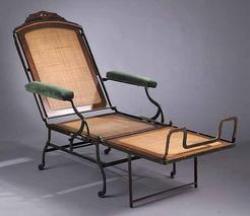
It turns out that Cevedra B. Sheldon was a designer/inventor as well.

On February 1, 1876, Sheldon was granted a patent for the invention of a new kind of reclining lounge chair/"invalid chair". The chair went into mass production by the Marks Adjustable Folding Chair Company of New York:

Image: Brooklyn Museum Collection

The Marks company defended its product line assiduously, bringing suit against imitators:

The Federal Reporter: Volume 43, Sept.-Dec. 1890

Many of these folding chairs appear to have survived and to come up for auction fairly frequently. A casual search on "Cevedra B. Sheldon" yields the following examples currently for sale:


Wednesday, June 9, 2010

Calder & Calder in 7th Street

Recently we noted rows of Park Slope buildings by the father-and-son team of Alexander G. Calder and William M. Calder in 8th Street and in 7th Avenue.

The prolific pair of Park Slope builders also apparently constructed in 1887 the long row of 10 brownstone-faced, three-story, three-family "flat houses" in 7th Street just above 7th Avenue:


476-506 7th Street
Alexander G. Calder, builder
William M. Calder, architect
- 1887


476-506 7th Street

The New Buildings permit was recorded in the April 9, 1887 issue of the American Architect & Building News:

"Building Intelligence; Tenement-Houses; Brooklyn, N. Y.," AABN vol. 21, no. 589 (Apr. 9, 1887): p. xii.
– "Seventh St., s s, 80' e Seventh Ave., 10 three-st’y brown-stone tenements, tin roofs; cost, each, $7,000; owner and contractor, A. G. Calder, 312 Thirteenth St., architect, W. M. Calder."

These lots are immediately adjacent to the 7th Avenue lots, developed a year later in 1888, also by Calder & Calder, with a row of five mixed-use (flats over stores) buildings facing 7th Avenue. Apparently the pair of developers managed to gain control over the entire 100' deep parcel extending from mid-block between 7th & 8th Avenues, all the way to 7th Avenue.

486 7th Street


498 7th Street - stoop detail


The permit recorded by the AABN was for 10 houses, and all 10 remain today, in essentially intact condition. This row is part of the Park Slope Civic Council's "Phase 1" proposal to extend the Park Slope Historic District.


Monday, June 7, 2010

Lost Park Slope - Charles Feltman Residence

Congratulations to reader "LGR" who correctly identified the subject of our recent "Lost Park Slope" feature as the former Charles Feltman mansion, which stood at the southwest corner of 8th Avenue and Carroll Street.

Below is another photograph of the Feltman mansion during demolition, along with the present 130 8th Avenue apartment house that replaced it. In the older photograph, one can also see the side of 140 8th Avenue, an Art Deco apartment building built in 1935-36.

Charles Feltman Residence
Montrose W. Morris, Architect (demolished ~1950
)
photo: Brooklyn Public Library


130 8th Avenue - Park Slope Historic District


The Brooklyn Eagle ran the top photograph in 1950, and the apartment house was constructed the same year, according to the Park Slope Historic District's Designation Report. It is likely that nearly all of Park Slope's taller apartment buildings replaced earlier mansions that became "soft" development sites only a few decades after they were built.

The Designation Report continues: "The palatial Romanesque Revival Feltman mansion, designed by Montrose W. Morris, was originally located on this corner. Charles L. Feltman was the inventor of the American "hot-dog-on-a-bun" of Coney Island fame, and Montrose W. Morris was the most popular architect among the wealthy residents on The Slope."

It is unclear when the Feltman residence was constructed. On January 2, 1891, when the Brooklyn Eagle announced the tragic death of Feltman's son, the family's address was given as 422 3rd Street, so the new mansion must not have been finished yet. The mansion somewhat resembles Morris's great Hulbert mansion on Prospect Park West, built between 1889-1892.

It was said that Charles Feltman "sold to the masses and lived with the classes." Such is the kind of palatial residence that hot dogs can buy. Feltman died in 1910 and is buried in Green-Wood Cemetery.

Sunday, June 6, 2010

Finding Aid & Guide to Resources

The campaign to expand the Park Slope Historic District is sponsored by the Park Slope Civic Council's Historic District Expansion Committee.

The Committee maintains several resources in support of this campaign:


I. Historic Park Slope Real Estate News.

The Committee maintains two web pages containing hundreds of transcriptions of historic real estate news about Park Slope. The news comes from the Brooklyn Daily Eagle, the American Architect & Building News, the New York Times, and other sources. The web pages are sorted by street address and can be searched via web browser.

URL for buildings facing the avenues: http://bk.ly/r9t

URL for buildings facing the streets: http://bk.ly/r9u


II. Photo Survey of Park Slope, Winter 2008-09.

The Committee photographed all of Park Slope in the winter of 2008-09 and the photographs have been uploaded to the web. Photographs are mostly of groups of related buildings, plus some street scenes and individual buildings. The photographs are grouped into "albums" by block (e.g. "north side of 11th Street between 7th & 8th Avenues") and are captioned by street address. The photographs can be enlarged and/or downloaded. All of the historic Park Slope Real Estate news maintained in the web pages (see above) is also maintained in the photograph comments.

URL for the Park Slope Photo Survey: http://picasaweb.google.com/pscc.hd.01


III. Department of Buildings Files for Park Slope.

The Committee is in the process of photographing files at the Brooklyn Department of Buildings, and making these files available on the web. These files are organized by block/lot number. Currently, only the west side of 7th Avenue from 10th to 15th Streets is available.

URL for the Dept. of Building files: http://gallery.me.com/andito72

Tuesday, June 1, 2010

Lost Park Slope

Time for another edition of "Lost Park Slope".

The mansion shown below is in the process of being demolished. Some of the doors and windows are boarded up, and a chute for debris drops from a window on the right side.

Where in Park Slope did this mansion once stand? Who designed it, when, and for whom? When was it demolished?:

Friday, May 28, 2010

Civic Council: New Park Highway Will Relieve Congestion?

This story marks the beginning of "driving season" this Memorial Day weekend.

If the Park Slope Civic Council were to advocate a new highway through Prospect Park to relieve traffic congestion, the idea would probably be universally condemned today.

Thankfully, when the South Brooklyn Board of Trade, the Park Slope Civic Council's ancestor organization, proposed this very idea in 1930, it was roundly condemned at that time as well, and the Park remained "inviolate". This forgotten story will surely resonate for anyone familiar with contemporary issues such as bike lanes, cars in the parks, and one-way vs. two-way streets.

The sponsor of this idea was Dr. J. Francis Ward, president of the South Brooklyn Board of Trade in 1930. Ward was also the city's Regional Director for Prospect Park at the time.

Ward advanced the idea to build a new highway through Prospect Park as a continuation of 9th Street, to relieve the "traffic jam" that was induced when 9th street was widened during the construction of the F subway line. Many other neighborhood groups voiced immediate opposition to the proposal, but parks officials gamely agreed to survey the park with Dr. Ward to assess the proposed highway's impact:

New York Times, July 13, 1930

Dr. Ward was apparently an adherent of the idea that the way to relieve traffic congestion is to pour ever more concrete. Regarding his wish for a "direct route... to the Sunrise Trail," one also wonders whether Dr. Ward might have had a weekend cottage on Long Island to which he was seeking a quick getaway:


Nathan Straus, Jr., president of the city's Park Association, was decidedly unimpressed by the proposal, calling it two days later a "park encroachment of the grossest and most objectionable kind." Ward, meanwhile, citing the opinions of "experts," vowed to continue the fight:

New York Times, July 15, 1930

Interestingly, communities south of the park opposed the plan, in contrast to today, when it is sometimes assumed that some in those communities seek to maximize vehicular access through and around the park. The Borough Park Neighborhood Association in particular threatened to litigate if the plan for a new highway through Prospect Park advanced:

A Mr. Davy, however, employed in the capacity of City Engineer, voiced the seemingly counterintuitive idea that "any new roads through the park would only add to the traffic jam there now," an idea now known as induced demand or "Build it and they will come" (along with its corollary, "Take it away and they will go"). Mr. Ward concludes with an appeal to "the facts," and expresses the opinion that a highway could become a "decorative part of the park:"


Even the way Dr. Ward frames his argument ("I am as heartily for the sentiment of natural beauty as my opponents, but...") finds echo in today's opposition to bike lanes ("I'm all for bikes, generally speaking, but...").

Of course we all know the end of this story. Thankfully, the highway was never built. As for Dr. Ward, president of the South Brooklyn Board of Trade, he was asked to resign from his post as director of Prospect Park, but he expressed no doubt that "time would show the wisdom of my plan:"

New York Times, July 24, 1930