Okay, we're crossing over 4th Avenue with this post, so some folks might say this isn't Park Slope any more. They might say it is Boerum Hill, or Gowanus. But we like to joke around that everything down to the Gowanus Canal is the "West Slope". Deal with it! Maybe we'll go down there some time and plant the Park Slope flag in the middle of Dean Street between 3rd & 4th. Willie Sutton, West Park Sloper
Willie Sutton (1901-1980) was an accomplished bank robber. It was he who famously responded, when asked why he robbed banks, "because that's where the money is." (Makes perfect sense to us!)
Sutton reportedly stole more than $2M during his career. He was a master of disguises, which earned him the nicknames "The Actor" and "Slick Willie". When not in disguise, he was apparently a sharp dresser. He was also good at breaking out of prison, escaping for the last time in 1932. He never killed anyone during his career, and although he carried weapons in the course of his robberies, they were reportedly never loaded, because he didn't want anyone to get hurt. The guns were just for show. After escaping in 1932, Slick Willie robbed a few more banks, but then laid low for many years. When the FBI created its "Most Wanted" list, in 1950, Willie was 11th on the list.
In 1952, 24-year-old Arnold Schuster was helping out in his father's tailor shop at 5507 5th Avenue in Sunset Park. Schuster was a bit of an amateur detective and was fascinated by the "Most Wanted" poster that had been dropped off in his father's shop by FBI agents. Schuster had studied it carefully for months, and had grown very familiar with the faces on the poster.
On February 18, 1952, Schuster had gone shopping in downtown Brooklyn, and had boarded a downtown BMT train at DeKalb Avenue for the trip home. As he gazed at the people seated across from him, one face seemed oddly familiar. He soon realized it resembled a face on the "Most Wanted" poster that he had been studying for months. The man across the aisle looked down, and then got off the train at Pacific Street, in Park Slope, the next stop.
Arnold Schuster also got off the train, and followed his man to a gas station at 3rd Avenue and Bergen Street. He then flagged down a couple of police officers, saying, "I think that guy is Willie Sutton."
 Gas Station, 3rd Avenue and Bergen Street -
Possibly the one to which Schuster trailed Sutton
The officers followed the man back to Dean Street between 3rd & 4th Avenues, where they found him changing a dead battery in his car in front of his rooming house at 340 Dean Street. The officers questioned him, and ultimately took him over to the precinct house at 6th Avenue and Bergen Street, a few blocks away, where he was positively identified as Willie Sutton, famous bank robber and escapee.
 78th Police Precinct House, 6th Avenue & Bergen Street
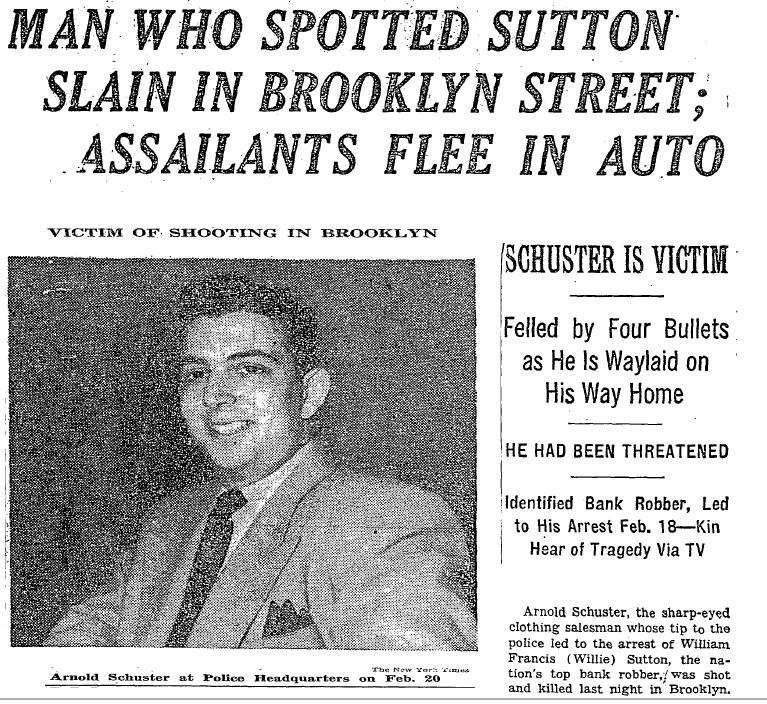
 New York Times account of Sutton's apprehension
March 9, 1952
It was a huge news story, and when Arnold Schuster's role in Sutton's apprehension was made known, he started receiving threatening phone calls and letters. One of the letters read, "You don't have long to live... Willie has friends."
On the evening of March 8, 1952, Arnold Schuster left his father's tailor shop and began walking to his home at 941 45th Street in Borough Park, between 9th & 10th Avenues, a distance of about a mile. He never made it. A few doors from his home, near the corner of 9th Avenue and 45th Street, he was gunned down, shot once in each eye and twice in the groin, if certain accounts can be believed. His body was found in the driveway adjacent to 913 45th Street. Despite a massive manhunt, his killer or killers were never apprehended.
 New York Times, March 9, 1952, p. 1
It was later claimed that Albert Anastasia, a leader of one of the so-called "Mafia" families, had ordered Schuster to be offed after seeing the story on television, exclaiming, "I can't stand squealers! Hit that guy!"
We first heard this story in 2003, and immediately took the bike over to 340 Dean Street to see if the building was still there. At that time it was still standing, although abandoned and boarded up:
 340 Dean Street (right) - 2003
Willie Sutton apprehended here
But we were surprised to find that even at that late date, Willie Sutton was not forgotten. Spray-painted on the doorway, back in 2003, superimposed with "KEEP OUT", were the words "Willy [sic] Sutton RIP":

340 Dean Street, 2003 - doorway
This was Willie Sutton's last hideout, just a few blocks from the Bergen Street precinct house; this was his home when he was apprehended due to the hapless Arnold Schuster.
Sometime in the last year or so, 340 Dean Street was demolished, to make way for what will undoubtedly be marketed as another "luxury condo" tower. The site has been quiet of late, so it appears that luxury may have to wait a bit longer in this part of the West Slope.
 340 Dean Street (right) - 2010
 All images: Brooklyn Public Library Brooklynology blog