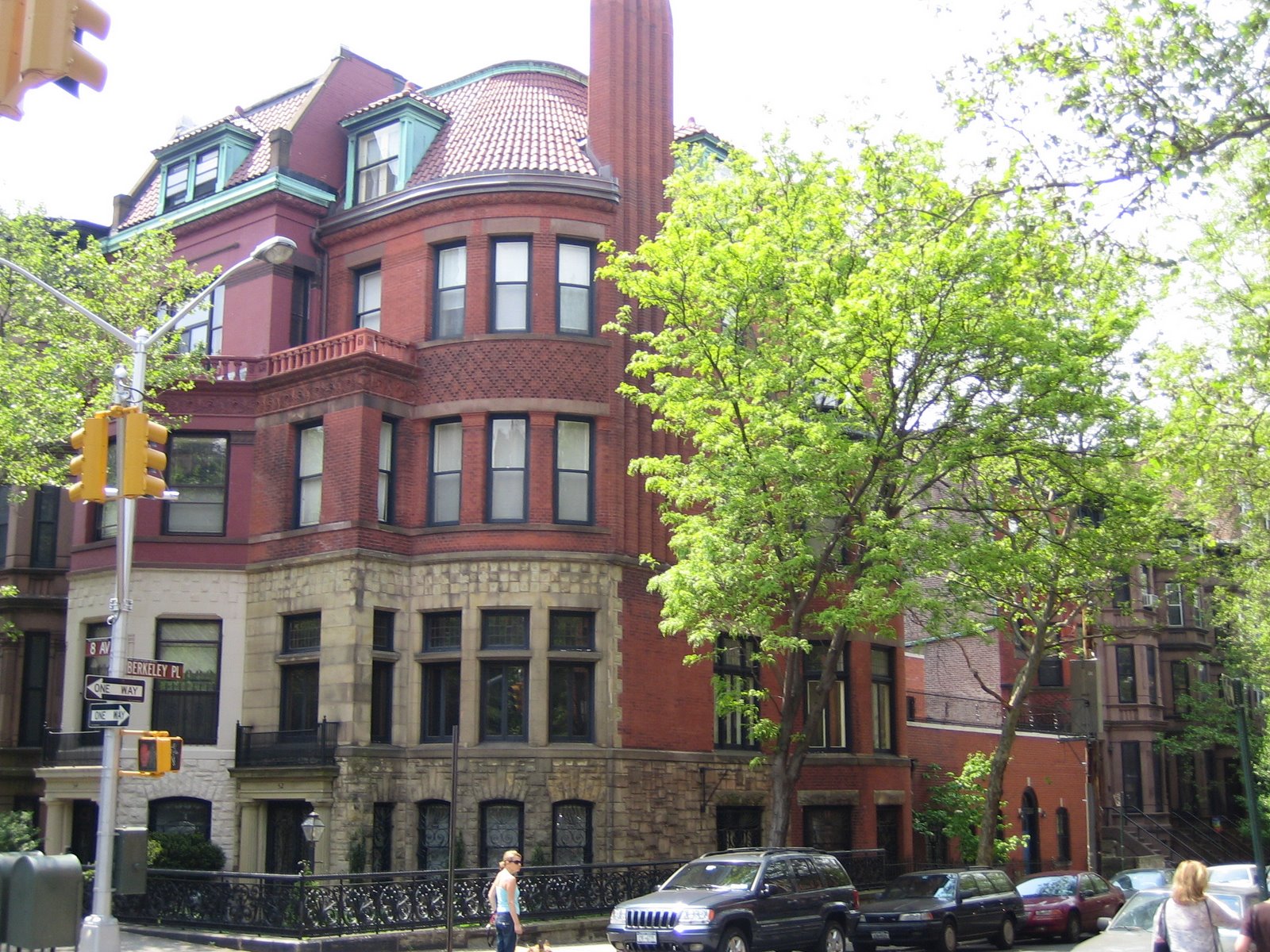
This house will be featured on the 2010 Park Slope House Tour, which will be held Sunday, May 16. Tickets will be available at 7th Avenue merchants, and through the Park Slope Civic Council's website. All proceeds from the House Tour are returned to the community through the Council's Grants Program.
Our next tour home, 614 2nd Street, is part of a longer row of 26 houses (#590-648) built as a single development. The row occupies most of the south side of the "park block" of 2nd Street. Regarding this row, the Park Slope Historic District's Designation Report tells us:
This long row of twenty-six houses was begun in 1903 for William H. Reynolds, representing the First Construction Company of Brooklyn, and was designed by Benjamin Driesler, a Brooklyn architect. It is an interesting example of the quest for variety, while at the same time utilizing certain standards of form, materials and architectural detail. Although at first the row has the appearance of a series of individually designed townhouses, a second glance reveals certain underlying similarities, with minor variations of detail intended to differentiate the houses. First, with regard to form, there is an alternating sequence of curved and three-sided bays; in addition, the end houses terminate the row with projecting square bays. Second, with regard to materials, there are three basic house types, all built upon brownstone basements: an all brownstone house, a brick above brownstone house, and an all limestone house. Third, there is the consideration of architectural style and details and how they are used relative to the houses of varying materials. The basic similarities of these houses are found in the uniform use of brownstone basements, Romanesque Revival L-shaped stoops, and neo-Classical sheetmetal cornices with small round bosses evenly spaced throughout. The houses are all slightly stepped down, as is noticeable at the cornices, to follow the slope of the street. ...The materials are used at random, and the limestone houses stand out quite boldly against their more sombre-hued neighbors. ...Architecturally, these houses all belong to the Eclectic period, when a wide range of styles was in use.
The architect, Benjamin Driesler, was born in Bavaria in 1869, and immigrated in 1881. He built a very successful architectural practice in Brooklyn, designing hundreds of houses in Park Slope, Prospect Heights, Prospect Lefferts Gardens, Ditmas Park, Midwood, and Kensington:
The developer, William H. Reynolds, served briefly as a New York state senator. He was a shrewd businessman whose ability to profit from public investments sometimes raised eyebrows:
Why this Blog Exists
To make the case for expanding the Park Slope Historic District
Showing posts with label Driesler. Show all posts
Sunday, March 21, 2010
Thursday, January 21, 2010
Builder Charles Peterson in 15th Street
People walking 15th Street between 8th Avenue and Prospect Park West pass a handsome row of white houses, each two stories of limestone over a brownstone basement floor:
Most of the houses have a full-height, three-sided bay; on some the bay is rounded. The stoops alternate, in ABAB pattern, between "straight" and L-shaped configurations.
The houses are nearly identical to other rows within the district such as this row on the north side of 9th Street, in the park block; the similarities extend even to the alternating straight and L-shaped stoops:
|
According to the Park Slope Historic District Designation Report, the 9th Street row was constructed in 1902-03 for William H. Reynolds, to designs by Brooklyn architect Benjamin Driesler. According to the Brooklyn Eagle, the 15th Street row was also begun in 1902, by builder Charles Peterson:
|
All of these houses of course post-date the great Columbian Exposition of 1893, which showcased the "White City" to the throngs that packed the Chicago fair for its 6-month run, and which helped finally to draw the curtain on brownstone's long dominance in urban neighborhoods like Park Slope. Our friend Francis Morrone has said one can generally estimate the age of a Park Slope building by its color: if brown, earlier than 1893; if white, later than 1893.
Note that these houses, though white on the upper two floors, still retain a brownstone stoop and basement floor. Perhaps it was hoped that brownstone at the base would be less likely to show the dirt from the gritty streets?
We believe that the Charles Peterson who built these houses is the same Charles Peterson who constructed the full blockfront on Prospect Park West between 6th & 7th Streets:
|
And we suspect it is the same Charles Peterson who built the "wrong-way" houses in 8th Avenue, just off Flatbush, whose backsides face their distinguished neighbors across 8th Avenue:
|
The plans created a huge stir in their day and actually caused gentlemen to leave the Montauk Club! Click here for more of this story... It is our personal theory, never before seen in print, that Peterson's architectural affront in 8th Avenue commenced Park Slope's long decline from its 1890s "Gold Coast" status, a decline that would not be turned around until the "brownstoner" movement of the 1960s.
Charles Peterson's 15th Street row is outside, but adjacent to, the current Park Slope Historic District; the line runs down the rear lot line between 14th and 15th Streets. The Park Slope Civic Council has asked the Landmarks Preservation Commission to consider this block in a proposed expansion to the historic district.
Most of the houses have a full-height, three-sided bay; on some the bay is rounded. The stoops alternate, in ABAB pattern, between "straight" and L-shaped configurations.
According to the Park Slope Historic District Designation Report, the 9th Street row was constructed in 1902-03 for William H. Reynolds, to designs by Brooklyn architect Benjamin Driesler. According to the Brooklyn Eagle, the 15th Street row was also begun in 1902, by builder Charles Peterson:
All of these houses of course post-date the great Columbian Exposition of 1893, which showcased the "White City" to the throngs that packed the Chicago fair for its 6-month run, and which helped finally to draw the curtain on brownstone's long dominance in urban neighborhoods like Park Slope. Our friend Francis Morrone has said one can generally estimate the age of a Park Slope building by its color: if brown, earlier than 1893; if white, later than 1893.
Note that these houses, though white on the upper two floors, still retain a brownstone stoop and basement floor. Perhaps it was hoped that brownstone at the base would be less likely to show the dirt from the gritty streets?
We believe that the Charles Peterson who built these houses is the same Charles Peterson who constructed the full blockfront on Prospect Park West between 6th & 7th Streets:
And we suspect it is the same Charles Peterson who built the "wrong-way" houses in 8th Avenue, just off Flatbush, whose backsides face their distinguished neighbors across 8th Avenue:
The plans created a huge stir in their day and actually caused gentlemen to leave the Montauk Club! Click here for more of this story... It is our personal theory, never before seen in print, that Peterson's architectural affront in 8th Avenue commenced Park Slope's long decline from its 1890s "Gold Coast" status, a decline that would not be turned around until the "brownstoner" movement of the 1960s.
Charles Peterson's 15th Street row is outside, but adjacent to, the current Park Slope Historic District; the line runs down the rear lot line between 14th and 15th Streets. The Park Slope Civic Council has asked the Landmarks Preservation Commission to consider this block in a proposed expansion to the historic district.
Labels:
15th Street,
8th Avenue,
9th Street,
Driesler,
Peterson,
Prospect Park West,
Reynolds
Subscribe to:
Posts (Atom)