Why this Blog Exists

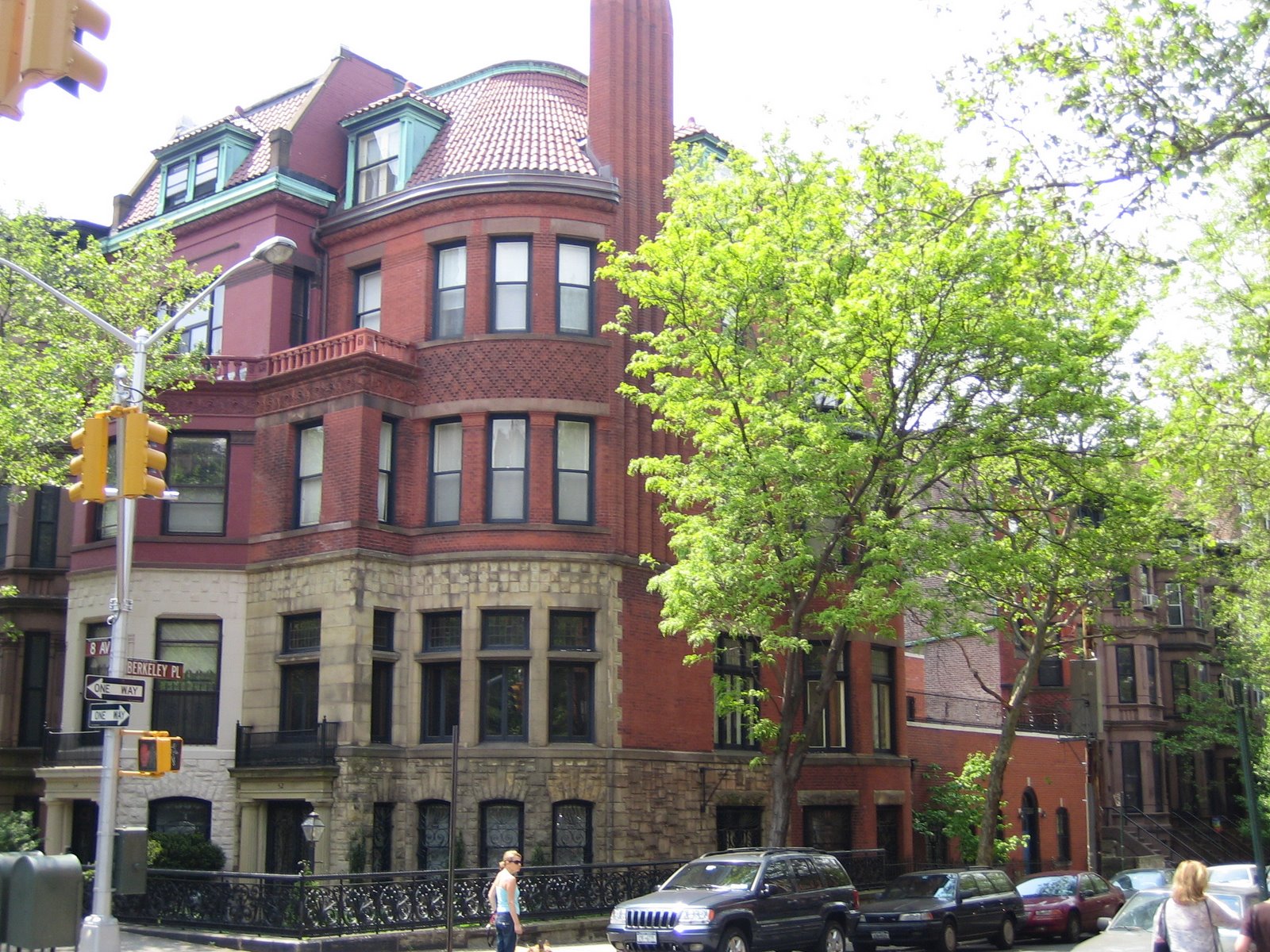
To make the case for expanding the Park Slope Historic District
Showing posts with label Doherty. Show all posts

Thursday, December 16, 2010

1960 Park Slope

We finally had a chance to review the exhaustive New York Times coverage of the 1960 Park Slope airplane disaster. A lot of great old photographs accompany the articles; the Here's Park Slope blog has a comprehensive then-and-now portfolio. What strikes us is how little the neighborhood has actually changed in the 50 years since the tragedy, thanks in part to the creation of the Park Slope Historic District.

While the buildings are largely the same, the photograph below reflects some of the other changes that the Slope has undergone in the last 50 years. The picture below shows the intersection of 7th Avenue and Park Place, the subject of one of our "Lost Park Slope" posts from a while back:

7th Avenue and Park Place, 1960
New York Times photograph

The building on the right is the truncated remnant of the Doherty Building at Flatbush and 7th; the B67 bus stop is right there. On the left stands #10 7th Avenue, one of the earliest houses in Park Slope, and one of a row of simple Italianate dwellings built circa 1865.

If you look closely, you can make out the sign for a business named "Paradise" on the ground floor of #10 7th Ave. What do you want to bet that the "Paradise" was one of the many saloons that once lined the avenue?

Perhaps the most poignant photograph, for us, shows 126 Sterling Place after part of the doomed jet had sliced through its cornice:

126 Sterling Place - 1960
New York Times photograph

The brick wall was repaired, but the cornice was never restored. 126 Sterling Place, one of a row of three identical apartment houses, is on the left in the photograph below.

126-122-118 Sterling Place

We have no knowledge regarding who designed or built these apartment houses, or when. Perhaps our ongoing research in the Real Estate Record and Builders' Guide will someday yield substantive information about them.

Saturday, March 27, 2010

Lost Park Slope: The Envelope Please

Our Lost Park Slope quiz asked readers to identify the location of the photograph below:

Where is this Park Slope location?

May we have the envelope please... Ruth Edebohls! correctly identifies the location as the corner of Flatbush and 7th Avenues. Below is the same location today; the view is from the Prospect Heights side of Flatbush, looking west across Flatbush at Park Slope:

Flatbush Avenue, 7th Avenue, and Park Place - 2010

The historic photograph is from the collection of the New York Public Library. The text on the verso reads:

The intersection of Flatbush Ave. and Park Place at Seventh Ave. The trolley tracks run northward on Flatbush Ave. At the left is the Durfey house, on the corner of Seventh Ave. and Park Place; beyond it appear Nos. 8-12 Seventh Ave. and the west side of Park Place. About 1912.

The Durfey house, with its wonderful front porch and mansard roof, on the left in the historic view, formerly stood at 158 Park Place, at the corner of Flatbush Avenue. Erected in 1872 in French Second Empire style, it was the home of Joseph Prentice Durfey, a successful jewelry merchant in New York, who died in 1900:

Brooklyn Eagle, June 26, 1900, p. 3 ("Obituary")
Correction: "Durfey & Shieble" should read "Durfey & Shiebler"

According to William Younger's essential Old Brooklyn Photographs, the Durfey house was occupied by the Durfey family until 1906. After later uses as a dancing school and restaurant, it was demolished in 1932. A 1-story commercial building now occupies the site. (N.b.: Younger reprints the same photograph, but identifies it as circa 1895.)

Younger's book identifies the building on the right, at the corner of 7th Avenue and Flatbush, as the Doherty Building. The building was standing at least as early as 1877, when the following ad appeared in the Brooklyn Eagle:

Brooklyn Eagle, March 12, 1877

The Doherty Building still stands today, although sadly its upper two stories were removed at some point. The original quoining can still be seen on its corners:

Doherty Building in 2010
Flatbush and 7th Avenues

The Doherty Building can be seen in the left foreground of the 1914 view below. The legend on the window identifies the occupant as "Brooklyn Post Office Station 86":

Doherty Building at left, 1914 view

In fact, except for the Durfey residence, all of the other buildings in the top photograph still stand today, albeit in somewhat altered form.

Thursday, March 12, 2009

2009 House Tour: 30 8th Avenue

30 8th Avenue is part of a row of flush-front neo-Grec houses from 1881-82, largely developed by owner-architect-builder, J. Doherty, who may have been the same person who built 199 Berkeley Place:

32-30 8th Avenue - Park Slope Historic District

Although it has lost its original front stoop, the house retains the handsome wrought iron cresting at the roofline. Horizontal banding at the basement level unifies the row. The house to the left, at #32, retains the original stoop, balustered handrailings, and newel posts.

Edward R. "Snapper" Garrison

In the late 1880s-early 1890s, this house was the residence of Edward R. "Snapper" Garrison, a "man of the turf", i.e. a horse-racing jockey, who became famous for hanging back during most of the race, only to finish at top speed to achieve a thrilling victory. He became so well-known for this racing style that a contest in which the winner pulls ahead at the last moment to score the victory is known as a "Garrison finish".

"Snapper" Garrison's career seemed bright in 1886 when he married Miss Sadie McMahon, daughter of a prominent Brooklyn judge. In addition to his career as a jockey, Garrison entered into business with his father-in-law, investing in stables and strings of racing horses. The New York Times noted on June 1, 1890, that this stretch of 8th Avenue was known as "Sportsmen's Row" due to the presence of Garrison and other sporting gentlemen.

Alas, by the early '90s, Garrison's business affairs had taken a turn for the worse, and he had had a falling out with his wife's father. The January 2, 1890 edition of the Brooklyn Daily Eagle recounts that "his riches had taken wings", that Garrison was "almost broke", and that his "differences with his father-in-law" had occasioned "no end of talk" in the racing circuit:

Brooklyn Daily Eagle, January 2, 1890, p. 6 ("Is It Impaired?")

Garrison managed to hang onto the house until 1896, when a Brooklyn Eagle article announced a special auction of his entire household effects "sold by the owner, a shining young member of the turf."

Brooklyn Daily Eagle, August 25, 1896

It must be observed that if one must suffer the embarrassment of having to vacate one's own house in this way, the best time to do it is in late August, when everyone is in the country.

Garrison later became a trainer and "man about the track". In September 30, 1919, the New York Times recounts that "Snapper" Garrison was involved in unpleasantries with a tailor in Ozone Park, Queens, regarding a bill for a two-pants suit:

New York Times, September 30, 1919

Garrison died in Brooklyn in 1930 and is buried in Holy Cross Cemetery.


New York Times, October 29, 1930

2009 House Tour: 199 Berkeley Place

199 Berkeley Place is the second house from the west end of a row of eleven neo-Grec brownstones begun in 1883 by Brooklyn owner-architect J. Dougherty & Son.

The incised vertical lines on either side of the doorway, and the geometric styling of the brackets supporting the door hood, characterize the neo-Grec style, which was a reaction against the rounded, more naturalistic forms of the earlier Italianate style. This house retains the original iron cresting on the slab over the doorway, behind which stands a full-height window dropping all the way to the floor:

199 Berkeley Place - Park Slope Historic District

The 1897 Lain's Brooklyn Directory lists Louis E. Blackwell, a broker in business in New York, in residence at 199 Berkeley Place:

BLACKWELL Louis E. broker 54 B'way N. Y. h 199 Berkeley pl

Louis Blackwell could well have been the first owner of the house, and may have bought it with his young bride and a family in mind. An 1887 "help wanted" advertisement in the Brooklyn Daily Eagle, only a few years after the house was built, requests the services of a "nurse" who is instructed to apply at 199 Berkeley Place:

Brooklyn Daily Eagle, July 14, 1887

By 1900, according to the Brooklyn Daily Eagle, at least one son, Louis Blackwell, Jr., was old enough to accompany his parents to a "national dinner" featuring Japanese cuisine at the nearby Montauk Club. It was reported that "...the women to whom the doors of the club house were thrown open, were particularly enthusiastic in their praises of dinner and decorations."

Under the heading "Brooklyn Society", in the June 16, 1901 issue, the Brooklyn Daily Eagle reported that Mr. and Mrs. Louis E. Blackwell had taken up residence in West Islip, Long Island, for the summer.

Upon returning to the city that fall, Louis E. Blackwell sold his seat on the New York Stock Exchange:

Brooklyn Daily Eagle, September 29, 1901

Perhaps he no longer required the position to support himself and his family, or perhaps his summer residence in the salutary ocean breezes of West Islip had left him less interested in his former career.

Louis Blackwell died in 1930, aged 79, having moved to East Orange, New Jersey. His New York Times obituary notes that he was descended from a former owner of Welfare Island (earlier Blackwell's Island, now Roosevelt Island) in the East River.


New York Times, September 17, 1930