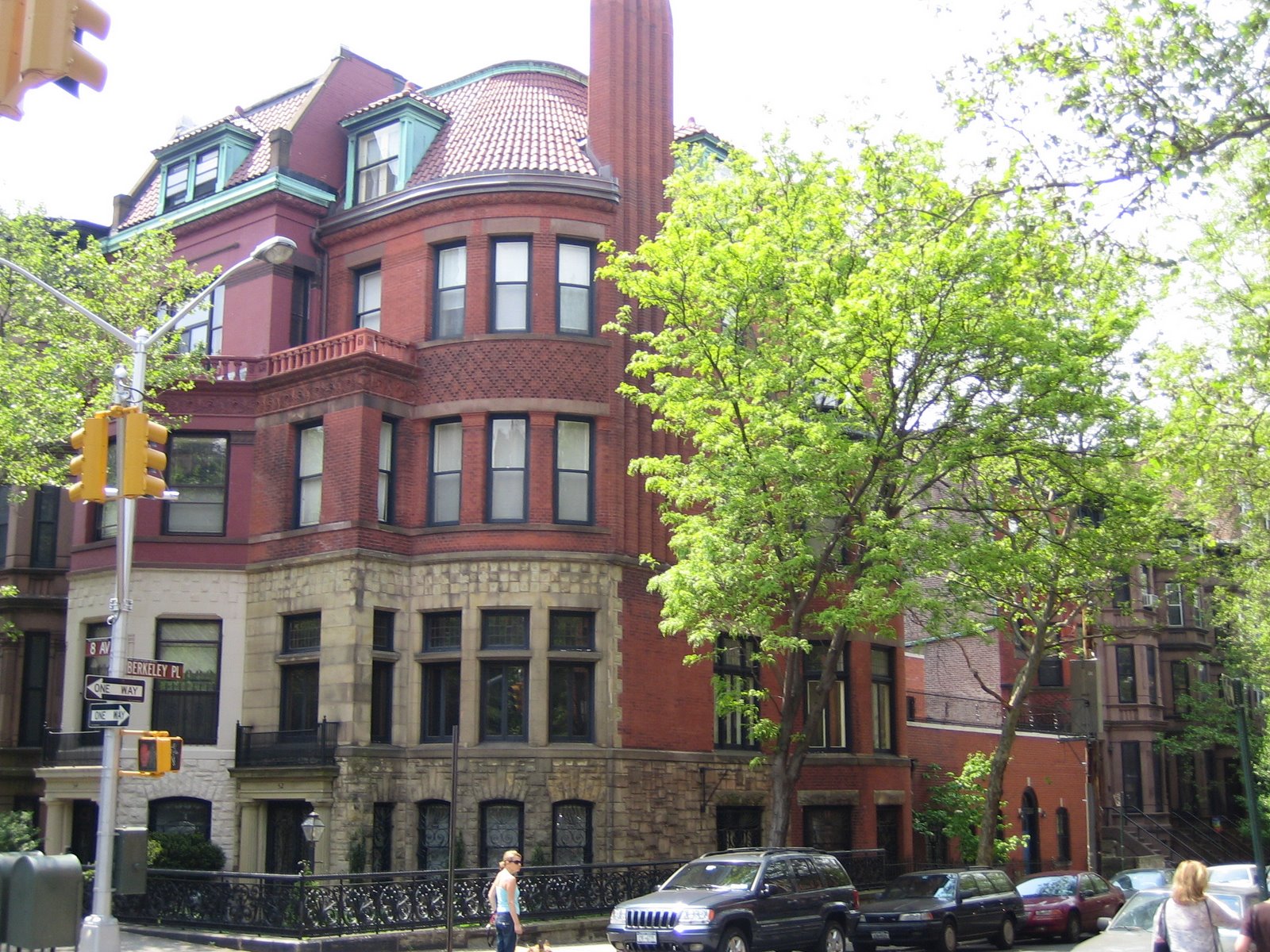
6th Avenue, 5th to 6th Streets, west side - unprotected
The central buildings compose a row of narrow (16'), brick-faced, 2 1/2 story-over-basement single-family houses built in 1888. The American Architect and Building News documents the row as follows:
"Building Intelligence; Houses; Brooklyn, N. Y.," AABN vol. 21, no. 575 (Jan. 1, 1887): p. xi.
– "Sixth Ave., s w cor. Fifth St., three-st’y brick store and dwell., tin roof; cost, $8,000; owner and builder, Thomas Butler, 389 Sixth St.; architect, W. H. Wirth.""Building Intelligence; Houses; Brooklyn, N. Y.," AABN vol. 22, no. 627 (Dec. 31, 1887): p. xiv.
– "Sixth Ave., w s, 20' s Fifth St., 10 two-st’y front, three-st’y on rear, brick dwells., tin roofs, wooden cornices; cost, each, $3,000; owner and builder, Thomas Butler, 389 Sixth St.; architect, W. H. Wirth.""Building Intelligence; Houses; Brooklyn, N. Y.," AABN vol. 23, no. 628 (Jan. 7, 1888): p. xvi.
– "Sixth Ave., n w cor. Sixth St., two-st’y and basement brown-stone dwell., tin roof, wooden and iron cornice; cost, $4,000; owner, Thomas Butler, 389 Sixth St.; architect, W. H. Wirth; builders, Buchanan & Riley."
The row is slightly unusual in that the end buildings, though differing from the central row, do not match each other. A 3-story, mixed-use (flats over store), brick building, which predates the rest of the row by about one year, stands at the 5th St. end, while the 6th St. end holds a two-story-over-basement, brownstone-faced single family house:
 6th Avenue & 5th Street, southwest corner - unprotected
All were however apparently built in 1887-1888 by owner Thomas Butler to designs by architect W. H. Wirth.
The original, narrow brick houses in the central row are quite charming and are mostly in original condition.
 370 6th Avenue - unprotected
Unfortunately one of the central row was "remuddled" at some point and had its cornice line raised to full height, breaking the row's symmetry:
 364-362A 6th Avenue - unprotected
We have encountered Thomas Butler before; he it was who built the long row around the corner in 5th St.
Wirth seems to have been an architect in highly localized practice. The 1897 Lain's Brooklyn Directory lists a Wm. H. Wirth in 17th St.:
WIRTH Wm. realestate 358 17th
WIRTH Wm. H. realestate 358 17th
Our documentary history of the Park Slope expansion study area lists many other buildings by W. H. Wirth, mostly smaller buildings toward the lower or southerly parts of Park Slope. A Brooklyn Eagle search confirms that he was not above designing the occasional "frame tenement".
Wirth was also a great promoter of development in the Windsor Terrace neighborhood. We suspect he may have held property there. The Brooklyn Eagle published several letters from W. H. Wirth advocating street improvements south of Prospect Park and the extension of Prospect Avenue (June 06, 1898, p. 8; September 03, 1897, p. 7).
Finally it should be noted that W. H. Wirth apparently chaired several subcommittees of the South Brooklyn Board of Trade, the 19th c. predecessor of the Park Slope Civic Council, the leading advocate for the current push to extend the Park Slope Historic District. The Brooklyn Eagle recounts the minutes of several meetings of the South Brooklyn Board of Trade in Acme Hall, still standing on the northwest corner of 7th Avenue and 9th Street, with committee reports from one W. H. Wirth. In his capacity on the South Brooklyn Board of Trade, he seems to have been an indefatigable advocate of development in the South Slope.